One of the ways you do well when working out and being in the zone is when you dedicate time over multiple weeks. This is great, it works for some time, but it doesnt become a lifestyle choice.
Your life will get over seeking the best time period to get in shape. Whats wrong with now? You hae other things to focus on now? Just dont make this into a high cognitive load.
People workout regularly
This is part of their lives. It’s something their day is dedicated to every day. They sleep, eat, work, deal with planning, and workout. This has been my struggle. Juggling all these things.
Even obama could workout regularly. If he can, then why not you?
🚨❗ Results of the FIRST EVER trial comparing ultra-processed food (UPF) and minimally-processed food (MPF) diets following healthy dietary guidelines on health (and the longest trial of UPF to date) published today in Nature Medicine
I havent run in a while. I was on a break. Now I have to start up again. lets go!
3 principles of base building
1- You can build for a lifetime Every low heart rate run, every aerobic session is an investment in your base. Your capacity for base is infinite. You’ll see real improvement after several months, much more if you stay consistent for years.
The real fast runners are that fast in large part because they’ve been putting in miles since high school and college. Same with fast adults, they’ve been stacking up years of training.
Your base fitness is durable. There are many cases of longtime runners stopping for years, then returning and getting back to a high level.
2- You can only build so quickly Your aerobic system will develop faster than your musculoskeletal system. It’s great if you’re motivated to run tons of miles, but bone density & tendon adaptations require time.
You can’t force fitness. You can’t just go from a 25 min 5k to a sub 20 min 5k in 4 months, no matter how hard you train. Your body can only progress at a given rate. Patience is essential.
Look to your 4-6 week previous load and historical load to guide ramp rates. See when/how you got injured and make adjustments. For example, coming off injury I was able to get back to 30 mile weeks quickly, but when I approach 70 mile weeks, it needs to be more gradual.
More cross training is a good way to get additional volume. I like an hour or more of aerobic training to match every hour run. Sign up for a 70.3 and you’ll build a solid base training for that. Or just be very active: swim, hike, ride your bike whenever you can.
3- You need some occasional breaks You can’t just build for 52 weeks a year. You need some time to decompress, physically and mentally.
Sign up for a couple main races. Build, peak, race, take time off or just try to maintain.
If you haven’t lifted weights, focusing on that for 3-6 months, 3-4x week can make you a better runner in the long term. Just jog a couple times a week or bike, you’ll come back stronger and faster than you expect.
3 principles of base building
1- You can build for a lifetime Every low heart rate run, every aerobic session is an investment in your base. Your capacity for base is infinite. You’ll see real improvement after several months, much more if you stay consistent for years.
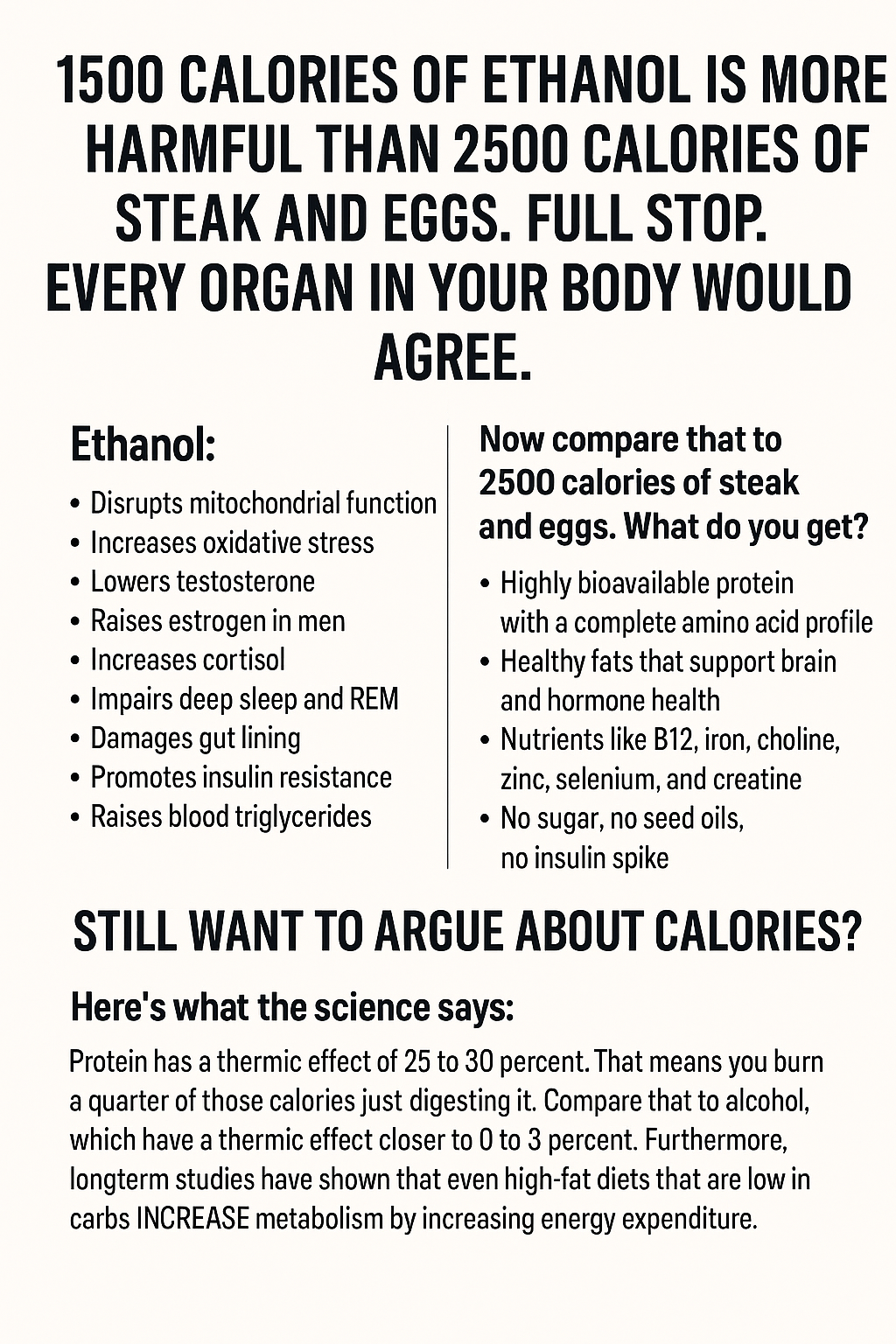
1500 calories of ethanol is more harmful than 2500 calories of steak and eggs. Full stop. Every organ in your body would agree.
Alcohol is not just empty calories. It is a metabolic toxin. When you drink it, your liver prioritizes it over everything else because it cannot be stored. This comes at a cost.
Ethanol: •Disrupts mitochondrial function •Increases oxidative stress •Lowers testosterone •Raises estrogen in men •Increases cortisol •Impairs deep sleep and REM •Damages gut lining •Promotes insulin resistance •Raises blood triglycerides
Now compare that to 2500 calories of steak and eggs. What do you get? •Highly bioavailable protein with a complete amino acid profile •Healthy fats that support brain and hormone health •Nutrients like B12, iron, choline, zinc, selenium, and creatine •No sugar, no seed oils, no insulin spike
Still want to argue about calories?
Here’s what the science says: Protein has a thermic effect of 25 to 30 percent. That means you burn a quarter of those calories just digesting it. Compare that to alcohol, which have a thermic effect closer to 0 to 3 percent. Furthermore, longterm studies have shown that even high-fat diets that are low in carbs INCREASE metabolism by increasing energy expenditure. Think about how many calories you would burn if you are in a carb and alcohol coma or hangover… the answer is very little.
Whole foods also support satiety signals like GLP-1, PYY, and CCK, while suppressing ghrelin. Processed foods and alcohol do the opposite.
And when it comes to fat loss, quality matters. You can gain fat in a calorie deficit if your hormones are broken, your sleep is wrecked, and your metabolism is inflamed.
A 1500-calorie alcohol-based diet will shrink your muscle, your bones, and your brain. A 2500-calorie nutrient-dense diet will preserve lean mass, improve metabolic function, and support long-term weight regulation.
So here’s the truth: If you are eating real food and still not losing fat, try eating less. If that doesn’t work, stop at 80 percent full. But always, always start with quality.
The caloric deficit is not what heals you. The food does.
If you want to wreck your hormones in a body building competition, go for it. Count away. Leave everyone else to real healing