Breaking through the running plateau

The Half-Mile Wall: Why Running Feels Impossible—Until It Suddenly Doesn’t

If you’ve ever hit a point in a run where your body seems to vote unanimously to stop, you know the feeling. Breathing gets loud. Legs feel heavy. Every step feels more expensive than the last. You’re not “tired” in a normal way—you’re urgent-tired.

For many new runners, that wall shows up somewhere around half a mile.

And the most confusing part isn’t the discomfort.
It’s the question underneath it:

Is this just how running works? Does it just keep getting harder the longer you go?

The answer is no—and understanding why changes everything.


The Lie of Linear Hardness

Most people assume running effort works like this:

  • ¼ mile = kind of hard
  • ½ mile = harder
  • 1 mile = twice as hard
  • 3 miles = impossible

That assumption is wrong.

Running effort is not linear. It’s front-loaded.

For many runners, especially beginners, the first 5–10 minutes are the hardest part of the entire run. If you survive that phase without crossing certain physiological lines, something surprising happens:

The effort stops increasing.

It doesn’t disappear—but it plateaus.

This is the difference between unsustainable running and sustainable running. And the sensation shift between the two is profound.


What Running Feels Like Before the Shift

Below the sustainability threshold, running feels like a countdown.

Common sensations:

  • Breathing ramps quickly and never settles
  • Your chest or throat feels tight or panicky
  • Legs feel hot, heavy, or rubbery
  • You’re constantly aware of how far you’ve gone
  • Every extra 30 seconds feels harder than the last

Mentally, your thoughts narrow:

“How much longer can I tolerate this?”

This is not weakness. This is aerobic mismatch.

Your body is borrowing energy faster than it can repay it. The bill comes due quickly.

When people say “I just can’t run far,” this is usually the state they’re trapped in.


What Changes When You Break Through

The first time someone crosses into sustainable running, they’re often confused by how… uneventful it feels.

Here’s what changes:

Breathing

Instead of escalating, breathing locks into a rhythm. It’s still elevated, but it stops demanding attention.

You’re no longer thinking about breathing—you’re just breathing.

Legs

The legs stop getting worse. They don’t feel fresh, but they feel predictable.

That “burning fuse” sensation disappears.

Effort

This is the big one.

Effort stops climbing.

You notice that:

  • The last minute didn’t feel harder than the minute before
  • You’re no longer counting steps to the next stop
  • Stopping feels optional instead of mandatory

The internal question shifts from:

“When do I have to stop?”

to:

“How long do I want to keep going?”

That is the shift.


Why This Feels Like a Wall (Not a Ramp)

Below the threshold, discomfort compounds quickly. Above it, discomfort spreads out slowly.

So from the inside, it feels like:

  • Below: “This is getting worse fast.”
  • Above: “This is… manageable.”

Because the transition is sharp, it feels like a block rather than gradual progress.

You don’t gain 200 yards at a time.

You gain a new state.


Why Easy Running Alone Often Doesn’t Get You There

This surprises people.

Running “easy” is necessary—but easy without progression teaches your body to stop at the same point.

Your nervous system learns:

  • How hard you go
  • How long you go
  • When you quit

If those variables never change, your body has no reason to rewrite the script.

Consistency builds the base.
Variation breaks the ceiling.


How to Systematically Break Through the Wall

This isn’t about pushing harder. It’s about changing how stress is applied.

1. Slow Down More Than Feels Reasonable

Most runners stuck at short distances are running just fast enough to stay slightly anaerobic.

The fix is uncomfortable at first:

  • Run at a pace that feels almost silly
  • You should be able to speak full sentences
  • If you feel embarrassed by how slow it is, you’re close

This alone moves many people across the threshold.


2. Use Run–Walk Before You Need It

This is critical.

Don’t run until you’re desperate and then walk.

Instead:

  • Run shorter than your current limit
  • Walk briefly
  • Resume before fatigue spikes

This teaches your body:

“Forward motion is continuous. Stopping completely is not required.”

Over time, the walk breaks shrink until they disappear.


3. Build Time, Not Distance

Distance is deceptive. Time is honest.

Your goal isn’t “a mile.”
Your goal is 10–15 minutes of forward motion, even with breaks.

Once your body tolerates time, distance arrives quietly.


4. Strengthen the Support System

At higher body weights, muscle fatigue—not cardio—is often the limiter.

Two sessions a week of:

  • Squats or sit-to-stands
  • Step-ups
  • Calf raises
  • Core stability

…can extend running distance dramatically, without changing fitness.


5. Learn the Difference Between Discomfort and Failure

This is subtle but powerful.

  • Discomfort: stable, annoying, breathable
  • Failure: escalating, panicky, urgent

The sustainable zone still contains discomfort—but it no longer escalates.

That’s how you know you’re on the right side of the line.


What Happens After the First Breakthrough

Here’s the part no one tells you:

Once you experience sustainable running once, it’s easier to return to it.

Your body now knows the state exists.

Future progress feels less like fighting a wall and more like extending a plateau.

That’s why people often go from:

  • ½ mile → 1 mile (hard)
  • 1 mile → 3 miles (shockingly fast)

The hard part wasn’t endurance.

It was access.


Final Thought

If you’re stuck at the half-mile wall, nothing is “wrong” with you.

You haven’t failed to toughen up.
You haven’t failed to lose weight.
You haven’t hit your limit.

You’re simply running just below the zone where running becomes sustainable.

And once you cross it, the experience changes—not gradually, but decisively.

If you want, I can help you:

  • Identify exactly where your threshold is
  • Design a simple progression that fits your current capacity
  • Or decode what your breathing and legs are telling you mid-run

The wall is real—but it’s not permanent.

Posted in Uncategorized

Reloading the Cave

I took a day off.

Not because I quit.
Because I was exhausted.

There’s a difference.

We glamorize constant output. Grind. Expansion. Scale. More. But even Batman disappears into the cave. Not to surrender — to reload.

That’s where I was.


The Quiet Fear

When you’re chasing multiple fronts at once — body, career, leadership, creative work — exhaustion doesn’t feel like fatigue.

It feels like doubt.

You start thinking:

  • What if I can’t trust myself?
  • What if I slip back?
  • What if I’ve tried before and this is just another cycle?

The villain isn’t pizza.
The villain isn’t beer.
The villain isn’t one missed workout.

The villain is the thought:

“Maybe I don’t have it in me.”

That’s the lie.


Evidence > Emotion

Let’s talk facts.

I’ve built difficult things before.
I’ve endured uncomfortable seasons before.
I’ve gone from zero to finishing something that once felt impossible.

Discipline is not foreign to me.

When I zoom out, the pattern is clear:
I don’t fail because I lack capacity.
I stall because I try to win the entire war in one day.

And when I can’t see immediate results, I assume nothing is happening.

That’s impatience — not incapability.


The 14-Day Rule

Here’s the recalibration.

Not six months.
Not the final weight.
Not the perfect physique.

Fourteen clean days.

  • Eat with intention.
  • Hit protein.
  • Move daily.
  • Lift with focus.
  • Sleep like recovery matters.
  • Avoid borrowed dopamine.
  • Earn it instead.

At my current weight, two disciplined weeks changes things visibly. Water drops. Face tightens. Energy stabilizes. Confidence returns.

Momentum doesn’t require a year.
It requires a block.


Borrowed vs Earned Dopamine

Borrowed dopamine:

  • Junk food.
  • Alcohol.
  • Binge scrolling.
  • “I’ll start Monday.”

Earned dopamine:

  • Finishing the run.
  • Hitting macros.
  • Closing your laptop at a sane hour.
  • Waking up clear.

Borrowed dopamine steals from tomorrow.

Earned dopamine compounds.

That’s the game.


The Real Reset

Taking a day off wasn’t weakness.

It was maintenance.

High performers burn out when they confuse exhaustion with inadequacy. They think rest means regression.

It doesn’t.

Rest without quitting is strategy.


The Only Question That Matters

Not:

  • “Will I reach the final goal?”
  • “What if I slip?”
  • “Why haven’t I transformed yet?”

The only question that matters is:

What does the disciplined version of me do tomorrow morning?

Not next year.
Not next month.

Tomorrow.

Stack that answer fourteen times.

Results follow.

Always.

Posted in Uncategorized

The Meditation for Men Who Refuse to Be Average

Most people meditate to relax.

That’s not what this is.

This is meditation for execution. For identity. For becoming dangerous in a disciplined way.

If your goals are big — lose 60+ pounds, build a body that looks expensive, run a marathon, dominate at work — you don’t need incense and soft music.

You need calibration.

Here’s the daily protocol.


1. Identity Lock (2 Minutes)

Sit upright. Eyes closed.

Repeat internally:

I build a body that cannot be bought.
I earn dopamine.
I execute the plan.

This isn’t affirmation fluff.
This is identity installation.

You don’t rise to goals.
You fall to identity.


2. Failure Visualization (3 Minutes)

Most people visualize success. That’s incomplete.

Visualize the other path:

  • Pizza boxes.
  • Beer.
  • Couch.
  • Netflix autoplay.
  • Missed workout.
  • Bad sleep.
  • Puffy face.
  • Monday regret.

Feel the weight of it.

Then say:

That path is available. I reject it.

You don’t ignore the shadow.
You confront it and choose differently.


3. Future Self Projection (3 Minutes)

Now flip it.

See:

  • Leaner jawline.
  • Strong shoulders.
  • Calm confidence in meetings.
  • Energy at 5 PM.
  • Marathon finish line.
  • Quiet self-trust.

Feel earned dopamine.

Not the quick hit.
The deep, earned satisfaction of discipline.


4. Tactical Alignment (2–5 Minutes)

Ask yourself three questions:

  1. What must be done today, no matter what?
  2. Where will I be tempted?
  3. What is the disciplined move instead?

Example:

Temptation: Stay at work until 8 PM and skip the workout.
Disciplined move: Leave at 5. Train. Log back in later if necessary.

Meditation isn’t escape.

It’s strategy.


Why This Works

This isn’t about being calm.

It’s about:

  • Installing identity
  • Confronting weakness
  • Visualizing consequence
  • Planning execution

You don’t need peace.

You need alignment.

Do this daily.

Because greatness isn’t built in the gym.
It’s built in the moments before you decide who you are.

Posted in Uncategorized

15 Intense, Low-Sugar Night Drinks

1. Hibiscus Tea (Hot or Cold)

Tart, wine-like, dry. Naturally relaxing and mildly vasodilatory.

2. Roasted Barley Tea (Mugicha)

Toasted grain, malt, clean finish. Zero caffeine. Very Speyside.

3. Rooibos Tea

Oak-adjacent, dried fruit notes, naturally smooth and calming.

4. Chamomile + Orange Peel

Floral with bitter citrus oil. Deeply relaxing without sweetness.

5. Orange Peel + Cardamom Tea

Warm citrus, spice, and wood. Sherry-cask energy without sugar.

6. Roasted Apple Peel + Cinnamon Stick

Dried apple, soft spice, gentle warmth. Peels only—no fruit.

7. Lemon Balm Tea

Green, herbal citrus. Calming without sedation.

8. Passionflower Tea

Earthy and grounding. Ideal for winding down a racing mind.

9. Dandelion Root Tea (Roasted)

Dark, bitter, coffee-adjacent. Excellent night substitute for espresso lovers.

10. Mineral Water + Expressed Orange Peel

Clean, sharp, adult. High mineral content supports relaxation.

11. Sparkling Water + Lime Peel + Sea Salt

Bitter, saline, refreshing. Strong vagus-nerve effect.

12. Rooibos + Orange Peel

Honeyed wood and citrus oil. Very Speyside-coded.

13. Chamomile + Micro-dose Vanilla Bean

Soft oak, floral warmth, rounded finish. Not dessert-sweet.

14. Warm Water + Magnesium Glycinate

Neutral, functional, deeply relaxing. Pure signal, no taste tricks.

15. Cold-Brew Hibiscus + Lime Peel

Wine-like acidity with citrus oil. Excellent late-night option.

Posted in Uncategorized

Casein vs Whey vs Real Food | Choosing the Right Protein When Cutting

When people talk about protein, the conversation usually stops at how much.
But if you’re trying to lose serious weight while staying strong—say 285 down to 220—the type of protein you choose may matter just as much as the total grams.

I learned this the hard way.

Drinking 60g of pure whey in the morning made me feel awful a few hours later:
energy crash, stomach upset, gas, fog.
But 70g of milk-protein or casein-dominant protein? I felt calm, strong, focused all day.

That wasn’t placebo. It was physiology.

This post explains why, compares common protein sources, and gives practical rules for fat loss.


The Real Goal During a Cut

When you’re carrying more bodyweight, success depends less on “maximizing muscle protein synthesis” and more on:

  • Energy stability
  • Hunger control
  • Gut tolerance
  • Adherence over months, not days
  • Preserving muscle without suffering

Protein that technically looks “optimal” on paper can still fail if it makes you crash or bloat.


The Two Big Dairy Proteins (and Why They Feel Different)

Whey

  • Fastest-digesting protein
  • Strong insulin response
  • Big leucine spike
  • Excellent post-workout tool

But:

  • Can cause blood-sugar dips afterward
  • Often causes GI distress
  • Hunger returns faster
  • Feels jittery or hollow for many people while cutting

Casein

  • Slow-digesting
  • Lower insulin response
  • Steady amino acid release
  • High satiety

This makes casein:

  • Easier on the gut
  • Better for appetite control
  • Better for long workdays and calorie deficits

Health isn’t about speed—it’s about stability.


Where Whole Foods Fit

Chicken, fish, eggs, soy—these are not whey or casein at all.

They contain muscle or plant proteins that digest at a moderate, steady pace, often landing right between whey and casein in terms of speed—but without lactose or fermentation issues.


Protein Comparison Table

Protein SourceProtein TypeDigestion SpeedInsulin ResponseSatietyGI RiskFat-Loss Usefulness
Whey isolateDairy (whey)Very fastHighLowHighSituational only
CaseinDairy (casein)SlowLowHighLowExcellent
Milk protein isolateCasein-dominant blendMedium-slowModerateHighLowExcellent
Skyr / Greek yogurtCasein-dominantSlowLow–moderateHighLowExcellent
ChickenMuscle proteinMediumModerateHighVery lowExcellent
FishMuscle proteinMedium-fastModerateHighVery lowExcellent
EdamameSoy proteinMedium-slowLow–moderateModerate–highLow–moderateVery good
Protein bar (casein-based)Casein + blendsMedium-slowModerateModerateVariableGood (bridge food)

Why Casein and Whole Foods Win During Fat Loss

If you’re cutting a lot of weight, you’re already asking your body to tolerate stress.

Fast proteins like whey:

  • Spike insulin hard
  • Clear quickly
  • Often leave you hungry again
  • Can disrupt gut comfort

Slower proteins:

  • Keep amino acids circulating longer
  • Reduce hunger
  • Reduce crashes
  • Improve adherence

Consistency beats theoretical optimization.


Hitting 180g Protein Without Whey

You do not need whey to hit high protein targets.

A realistic day might look like:

  • Morning: casein or milk-protein shake (50–60g)
  • Midday: skyr, chicken, or fish (40–50g)
  • Evening: whole-food protein meal (50–70g)

That’s 160–180g, no crashes, no GI chaos.


Practical Recommendations

Use as your default:

  • Casein or milk protein isolate
  • Skyr / Greek yogurt
  • Chicken, fish, lean meats
  • Edamame and other complete plant proteins

Use sparingly or optionally:

  • Whey (≤30g, post-workout only)
  • Protein bars (once per day, bridge only)

Avoid as a base:

  • Large fasted whey doses
  • Hydrolyzed whey
  • “Protein purity” chasing at the expense of how you feel

Simple Heuristics (Save These)

  • Protein that makes you crash is not healthy—for you.
  • Morning = slow protein.
  • Cutting = stability beats speed.
  • Adherence > optimization.
  • If it keeps you full, calm, and consistent, it’s the right protein.

Final Thought

The healthiest protein isn’t the leanest, fastest, or most anabolic.

It’s the one that lets you:

  • Stay in a calorie deficit
  • Train consistently
  • Think clearly
  • Sleep well
  • Repeat the process tomorrow

For many people cutting from 285 to 220, that protein is casein-dominant and whole-food based, with whey used only as a tool—not a foundation.

If you want, the next step could be:

  • A zero-whey 180g day template
  • A travel-proof protein strategy
  • Or turning this into a shorter, punchier version for posting

Posted in Uncategorized

Best male status symbols

Best male status symbols

· Fit body
· Well read
· Optimistic
· High energy
· Loving home
· They have a quest
· Lives with integrity
· Avoids drama and gossip
· Surrounded by family and friends
· Kids love spending time with them
· Makes money doing something he believes in
6:53 AM · Feb 21, 2026
·
97.5K
Views

Posted in Uncategorized

Starvation

Damn dude, when I am getting 180g a day, I feel AMAZING.

Without it, I start to collapse. Drinking, carbs, etc.

This is it. I got it. 180g protein and fiber.

Posted in Uncategorized

Active Recovery Protocols

3-Day Active Recovery Reset (Friday–Sunday)

Objective:
Lower inflammation. Reset dopamine. Restore sleep. Rebuild discipline momentum.

No heroics. No ego lifting. No chaos.


DAY 1 — Nervous System Downshift (Friday)

Theme: Calm the system.

Morning

  • 30–45 min Zone 2 walk (nose breathing only)
  • 10 min mobility (hips, thoracic spine, ankles)
  • Sunlight in eyes within 30 min of waking

Food

  • 2100 calories
  • 180g protein
  • High fiber (30g+)
  • Low sugar
  • 3L water
  • Zero alcohol

Eat like a professional athlete.

Midday

  • 20 min nap OR 20 min NSDR (YouTube)
  • No social media scroll

Evening

  • Light stretch
  • Phone off at 8:30pm
  • In bed 9:30–10

You are lowering cortisol.


DAY 2 — Rebuild Structure (Saturday)

Theme: Control returns.

Morning

  • 30 min easy run (conversational)
  • 20 min light full-body strength (60% effort)
  • Sauna or hot shower after (optional)

Nutrition

  • Same 2100 / 180g protein
  • Heavy vegetables
  • One protein shake max
  • No junk
  • No “earned” cheat

This is earned dopamine territory.

Mind

  • Write:
    • 3 things I’m proud of
    • 3 reasons 2026 NYC Marathon matters
    • 3 reasons I am capable

You ran a marathon from the couch in 2024. That’s evidence.


DAY 3 — Identity Lock-In (Sunday)

Theme: I am the guy who trains.

Morning

  • 45–60 min Zone 2 run/walk
  • 15 min core
  • Cold shower finish

Weekly Planning
Write:

  • 3 MITs (Most Important Tasks) for work this week
  • Workout schedule (exact times)
  • Protein plan (what restaurant when)

Remove decision fatigue.

Sunday 8pm → Monday 8pm Fast (your standard weekly fast)
That’s discipline ritual.


What This 3-Day Reset Does

  • Sleep improves
  • Inflammation drops
  • You feel lighter
  • Mental chatter decreases
  • You rebuild trust with yourself

Trust is built in 72 hours.


If You Had 9 Days Off (Full Reset Protocol)

This is a different level. This is a phase transition.


Phase 1 (Days 1–3): Detox & Calm

Same as above.
Add:

  • Delete Instagram for 9 days
  • No alcohol
  • 10k+ steps daily
  • Clean apartment fully

Environment = psychology.


Phase 2 (Days 4–6): Physical Rebuild

Daily

  • 45–60 min Zone 2
  • 30 min strength (push/pull/legs rotation)
  • 1 long run (75–90 min easy)

Macros:

  • 2100–2200 calories
  • 180g protein
  • 35g fiber
  • 3–4L water
  • Berberine + Vitamin D (don’t skip)

Body starts leaning out visibly.


Phase 3 (Days 7–9): High Performance Lock-In

This is where you shift identity.

Daily Structure

  • Wake at same time every day
  • Deep work block (2 hours)
  • Workout at same time
  • No late night screens
  • Meal template locked

Add:

  • One 24-hour fast
  • One long reflective walk (2 hours)
  • Write a 1-page “220lb Identity Manifesto”

Not goals.

Identity.

Example:

I am disciplined even when tired.
I don’t negotiate with cravings.
I train daily.
I eat like an athlete.
My body is a luxury item that cannot be bought.


The Real Reset

Your fear is not weight.
It’s that you don’t trust yourself.

So resets are not about calories.

They are about:

  • Proving you can execute for 3 days.
  • Then 9 days.
  • Then 90 days.

Momentum > intensity.

Posted in Uncategorized

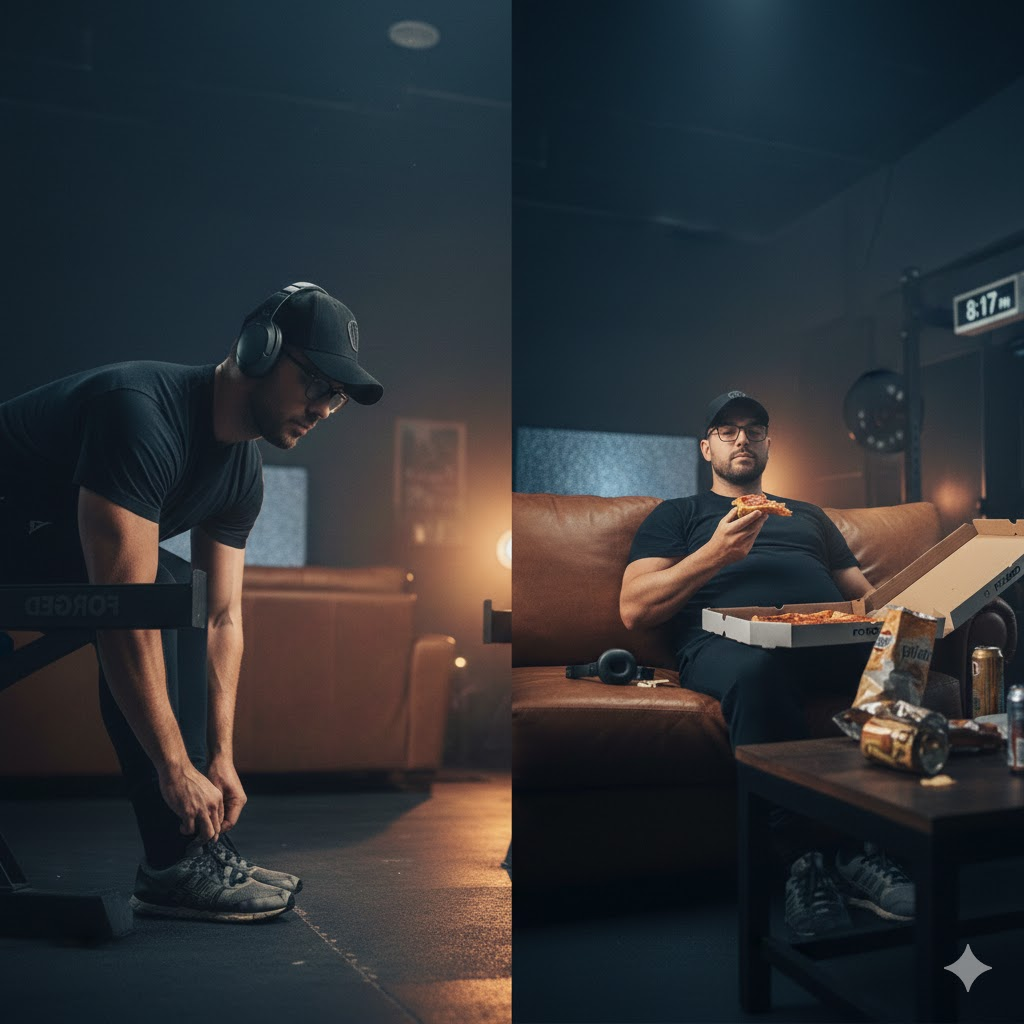
The Man at 8:17 PM

At 8:17 PM, the war starts.

The workday is over.
The brain is fried.
The pressure hums like static.

And gravity pulls.

Not just toward pizza.
Toward the couch.

That’s the real enemy.


It’s easy to blame food.

Pizza is obvious.
Beer is measurable.
Calories can be counted.

But stagnation?
That’s invisible.

You can overeat slightly and still recover.

But when you sit down and don’t train?

You reinforce something dangerous.

“I’ll start tomorrow.”

That sentence builds nothing.


Borrowed dopamine isn’t just junk food.

It’s avoidance.
It’s scrolling.
It’s letting autoplay make decisions for you.
It’s negotiating with weakness.

It feels like relief.

It’s erosion.


There is another version of 8:17 PM.

Shoes on.
Door open.
Thirty minutes moving.
Thirty minutes under iron.

No motivation.
No hype.
No cinematic soundtrack.

Just reps.

Earned dopamine is quiet.
But it compounds.


The workout is not about calories.

It’s about identity.

Every time you train, you cast a vote:

“I am not the man who negotiates.”

Every time you sink into the couch and delay?

You cast the opposite vote.


You can buy status.
You can buy luxury.
You can buy comfort.

You cannot buy discipline.
You cannot buy endurance.
You cannot buy self-trust.

That is forged.

At 8:17 PM.

Posted in Uncategorized

The Man on the Couch : Anesthesia is EASY to buy – Momentum is NOT

There are two versions of a man.

One runs toward discomfort.
The other negotiates with it.

The difference between them is not talent.
Not intelligence.
Not opportunity.

It’s dopamine.


He knows exactly how it happens.

The day runs long.
Meetings stack.
Responsibility expands.
Everyone needs something.

By 8:17 PM the brain is cooked.

That’s when the whisper arrives.

You deserve this.
Just tonight.
You’ll reset tomorrow.

Pizza.
Beer.
Couch.
Streaming platform autoplaying into infinity.
Midnight becomes 1:30.
Sleep fractures.
Morning feels heavy.

The body is softer.
The mind is duller.
The guilt is precise.

This is borrowed dopamine.

It is a loan shark.
It pays instantly.
It collects with interest.


The terrifying part?

He doesn’t fear gaining weight.

He fears becoming the man on the couch.

The man who chooses relief over growth.
The man who confuses comfort with reward.
The man who slowly negotiates away his edge.

That’s the real nightmare.

Not failure.

Drift.


High performers don’t usually collapse.

They erode.

A little later at work.
A little less sleep.
A little more stress.
A little more “I’ll fix it next week.”

The brain, overloaded, looks for anesthesia.

Anesthesia is easy to buy.

Momentum is not.


There is another version of the night.

It looks boring.

Leave work at five.
Thirty minutes of running.
Thirty minutes under iron.
Protein.
Reasonable calories.
Lights out on time.

No applause.
No cinematic montage.
No dramatic soundtrack.

But the next morning?

The spine is straighter.
The mind is quieter.
The mirror is honest.

That is earned dopamine.

It compounds.


Self-trust is not built in heroic sprints.

It is built in small, almost forgettable victories.

Did you run?
Did you lift?
Did you eat like someone who respects himself?
Did you sleep?

Yes or no.

That’s the scoreboard.


The modern man can buy almost anything.

Luxury condo.
Performance car.
Status symbols that glitter under Manhattan lights.

But he cannot purchase:

A 220-pound, disciplined frame.
A marathon crossed under his own power.
A nervous system that does not flinch at discomfort.

Those are forged.

In repetition.
In restraint.
In choosing tomorrow over tonight.


Here is the truth:

The war is not against food.
Or alcohol.
Or laziness.

The war is against drift.

Against the slow erosion of edge.
Against the subtle voice that says, You can ease up now.

Because easing up is easy.

Becoming sharp is not.


There are two versions of a man.

One negotiates with weakness.
The other trains.

Every night, around 8:17 PM, they meet.

And only one walks away.


Borrowed Dopamine vs Earned Dopamine

There’s a version of failure that most people don’t talk about.

It’s not dramatic.
It doesn’t look like catastrophe.

It looks like pizza.
Beer.
A couch.
Back-to-back movies.
Bad sleep.

And the quiet feeling that you slipped again.

For a long time, I thought my struggle was about food. Or discipline. Or motivation.

It wasn’t.

It was about identity.


The Real Fear

When I imagined failing, I didn’t imagine gaining weight.

I imagined becoming someone who:

  • Chose relief over growth
  • Chose numbness over progress
  • Chose comfort over momentum

The food wasn’t the issue.
It was what the food represented.

Borrowed dopamine.


Borrowed vs Earned Dopamine

Here’s the framework that changed everything for me:

Borrowed dopamine

  • Alcohol
  • Junk food
  • Doom scrolling
  • Avoidance
  • Escaping discomfort

It feels good immediately.
But tomorrow is worse.

Earned dopamine

  • Training when you don’t feel like it
  • Leaving work on time to take care of your body
  • Delegating instead of hoarding stress
  • Hitting protein and calorie targets
  • Going to bed on time

It doesn’t always feel amazing in the moment.
But tomorrow is stronger.

One compounds anxiety.
The other compounds self-trust.


The Hidden Variable: Self-Trust

Most people don’t fail because they don’t know what to do.

They fail because they don’t trust themselves to follow through.

I didn’t need another plan.
I didn’t need a more optimized macro breakdown.
I didn’t need a better calculator.

I needed proof — daily proof — that I could keep promises to myself.

Self-trust isn’t built with heroic weeks.
It’s built with boring days.

  • 30 minutes of movement.
  • Reasonable calories.
  • Enough protein.
  • Go to sleep.
  • Repeat.

That’s it.


Stress Is the Real Trigger

When work expands.
When responsibility grows.
When expectations rise.

The brain looks for relief.

And relief often disguises itself as “I deserve this.”

But most of the time, what we deserve is momentum.

Overwork leads to cognitive overload.
Cognitive overload leads to decision fatigue.
Decision fatigue leads to borrowed dopamine.

This isn’t weakness.

It’s biology.

Once you see the chain, you can break it.


You Don’t Need Perfect. You Need Direction.

There’s a dangerous belief high performers carry:

“If I’m not progressing on everything, I’m falling behind.”

That belief is exhausting.

You don’t need to win every day.
You don’t need to fix everything at once.
You don’t need a complete reinvention.

You need direction.

Forward.
Even slightly.
Even imperfectly.


The Luxury You Can’t Buy

Money can buy watches.
Cars.
Apartments.
Status.

But it can’t buy:

  • A strong body.
  • Discipline.
  • Endurance.
  • The feeling of control over your impulses.

Those are built.

Brick by brick.
Rep by rep.
Meal by meal.

Your body can become a luxury item that no one else can purchase for you.

That’s earned dopamine.


The Reset

When things feel overwhelming, simplify:

  • Move your body.
  • Eat within reason.
  • Prioritize protein.
  • Sleep.
  • Reduce unnecessary work stress.
  • Repeat.

No dramatic overhaul.
No identity crisis.
No spiral.

Just reps.

Because drifting isn’t defeat.

And you’re not trying to become perfect.

You’re trying to become someone who keeps promises to themselves.

That’s the real transformation.

Posted in Uncategorized